Case Study: Turning Recruitment Group Chats into Automatic Matching, Push and Lead Generation
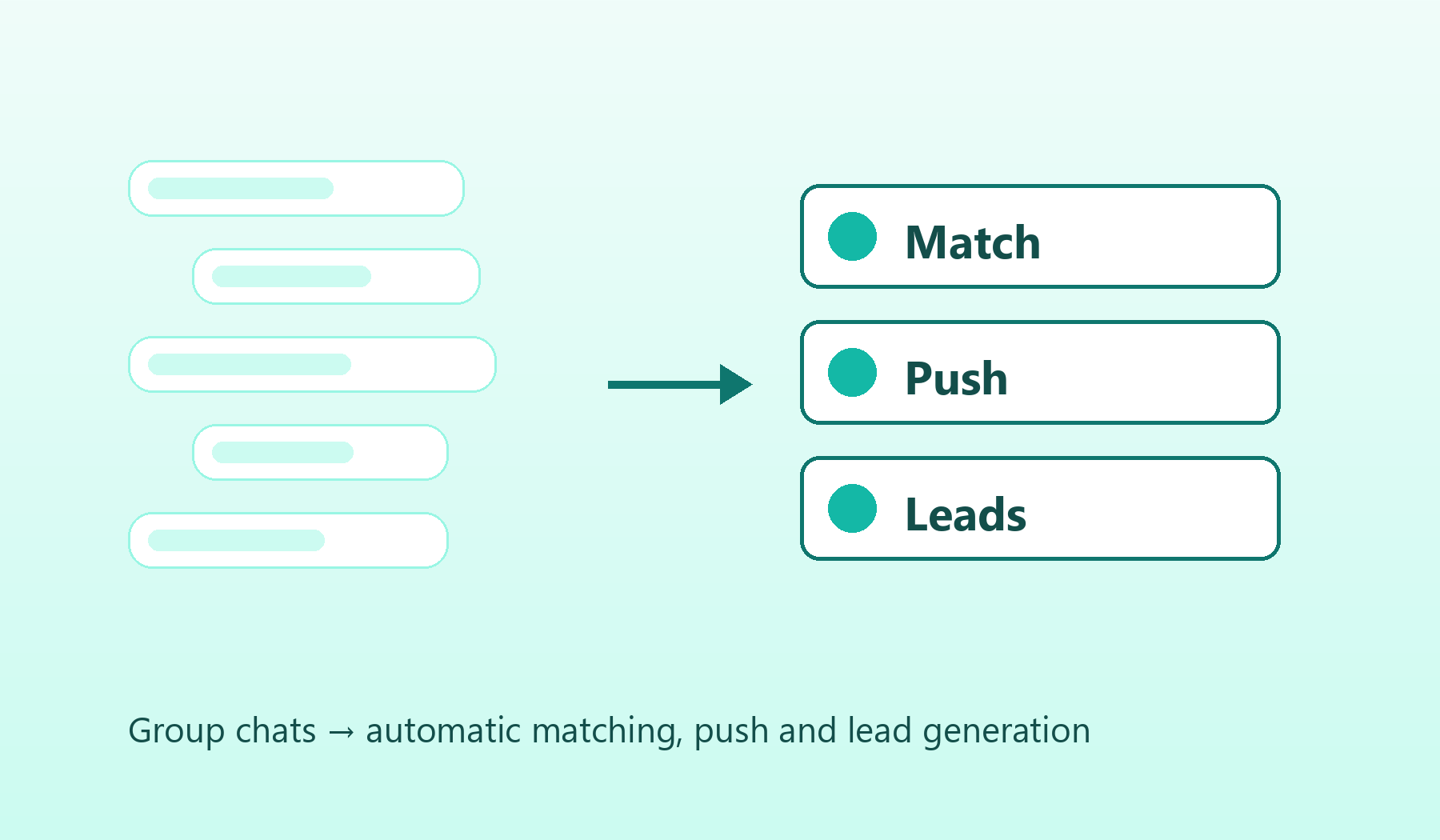
Table of Contents
The situation
A multinational manpower and recruitment agency ran its daily business inside instant-messaging group chats. Candidate résumés and employer job orders arrived as files, photos and free-text messages, often forwarded several times across different groups.
Staff copied everything into spreadsheets by hand. Scanned forms were hard to read, the same candidate appeared again and again, and when a new job order came in, finding the right people meant scrolling and searching. Good candidates were often contacted too late — and new employer demand mentioned in the groups was easy to miss.
How we worked: embedded, not outsourced
Instead of asking for a specification, our forward deployed engineer joined the agency’s day-to-day workflow. We watched how résumés and job orders really arrive, which fields recruiters actually use to decide, and where follow-up gets lost. The system was then built and deployed directly on the agency’s own server, one working slice at a time.
What we built
- Collection through the messaging platform’s official chat archive API: group messages, files, images and nested forwarded messages, with per-group switches so only approved groups are processed.
- Parsing of résumés and job orders in PDF, Word, legacy DOC/WPS, Excel, HTML and image formats, including scanned tables. Chinese OCR results are cross-checked, and uncertain fields are flagged for human review instead of guessed.
- De-duplication by actual file content and by name plus phone number, so a résumé forwarded many times becomes one candidate record.
- Automatic matching: candidates are matched to job orders by position, location, salary, work-permit conditions and other requirements, so recruiters start from a ranked shortlist instead of a search box.
- Push to the right people: new matches and new job orders are pushed to the responsible recruiters and group members as soon as they appear, so good candidates are contacted while they are still available.
- Lead generation: employer demand collected from group chats is captured as structured leads, giving the business team a continuous source of new clients and job orders.
- Full history: every automatic or manual change keeps a before-and-after snapshot and its source message.
- Role-based workbench for administrators, résumé-group members and job-group members, each seeing only what they are allowed to see.
- Privacy by design: all processing runs on the client’s own infrastructure, and résumé content is not sent to external AI models.
Python · FastAPI · PostgreSQL · Redis · Next.js · OCR
The result
Intake, matching and follow-up moved from manual copying and searching to an automatic pipeline. Résumés and job orders become searchable records, matches are pushed to recruiters, and new employer demand turns into leads. The system was delivered quickly, at low cost, and runs in the client’s own environment.
Why this is a forward deployed engineering problem
The hard part was never the code. It was understanding how a busy recruitment team really works — which groups matter, which fields decide a placement, when a recruiter needs to be alerted — and turning that into a system people actually use every day. That is exactly what an embedded engineer is for.
If your business runs on group chats, spreadsheets and manual follow-up, tell us how the work flows today. Every engagement starts with a short call and a small, fixed-scope paid pilot.